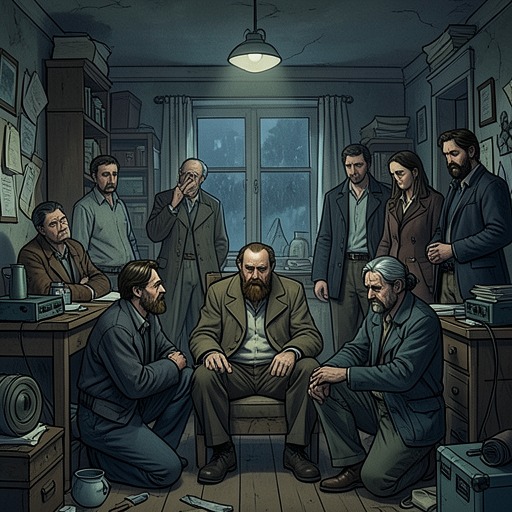
Collective responsibility
The Brothers KaramazovCollective responsibility is the moral conviction that people are bound to answer for one another and for the suffering of all, including those they have not personally harmed. In Dmitri’s reflection on the mines, the principle turns shared guilt into a charge to act: he accepts punishment for his father’s murder despite insisting that he did not kill him, because he believes someone must go for all and because the suffering of the “babes” makes responsibility unavoidable.
Meaning and Scope
Dmitri’s formulation refuses to confine responsibility to direct personal wrongdoing. He imagines hundreds of convicts and murderers, each a person in whose heart another human being might still be found. Their crimes do not erase their capacity for friendship, love, suffering, or change; nor does their guilt belong only to them. “We are all responsible for all” expands the moral field beyond the individual offender to the people who might stand beside him and respond.
The principle reaches beyond literal children. Dmitri explains that there are big children as well as little children and calls them all “babes.” The word gathers vulnerable and suffering people into one category of moral concern, rather than making responsibility depend on age, innocence, or a close personal bond. His question about why the babe is poor becomes, in retrospect, a sign that directs him toward this wider obligation.
Responsibility as Action
The mines give the principle a concrete setting. Dmitri imagines breaking ore with a hammer beside another convict and murderer, and fears not the labor itself but the possibility that the “new man” may leave him. Even underground, however, companionship remains possible: one can make friends with a fellow prisoner, wait upon him for years, and help thaw and revive a frozen heart.
That work is described as a patient recovery of human possibility from darkness. Dmitri imagines bringing a lofty soul and a feeling, suffering creature up from the depths, even bringing forth an angel or creating a hero. Responsibility therefore means more than acknowledging a general connection to wrongdoing. It calls for sustained attention to another person, including someone condemned for a crime, and for labor that might help restore what suffering has frozen.
The Babe and Accepted Suffering
Dmitri connects the dream of the poor babe to his decision to accept punishment. The remembered question does not prove that he committed the murder; he explicitly says that he did not kill his father. Instead, the dream gives his suffering a collective meaning: he is going for the babe, for all the babes, and because someone must go for everyone.
The conviction does not collapse legal guilt and moral responsibility into the same thing. Dmitri’s acceptance is not a confession to the murder; it is a willingness to bear suffering in the name of a responsibility that exceeds individual culpability. The idea’s force lies in that distinction: even as he denies the crime, he refuses to treat his innocence as permission to stand apart from other people’s pain.